
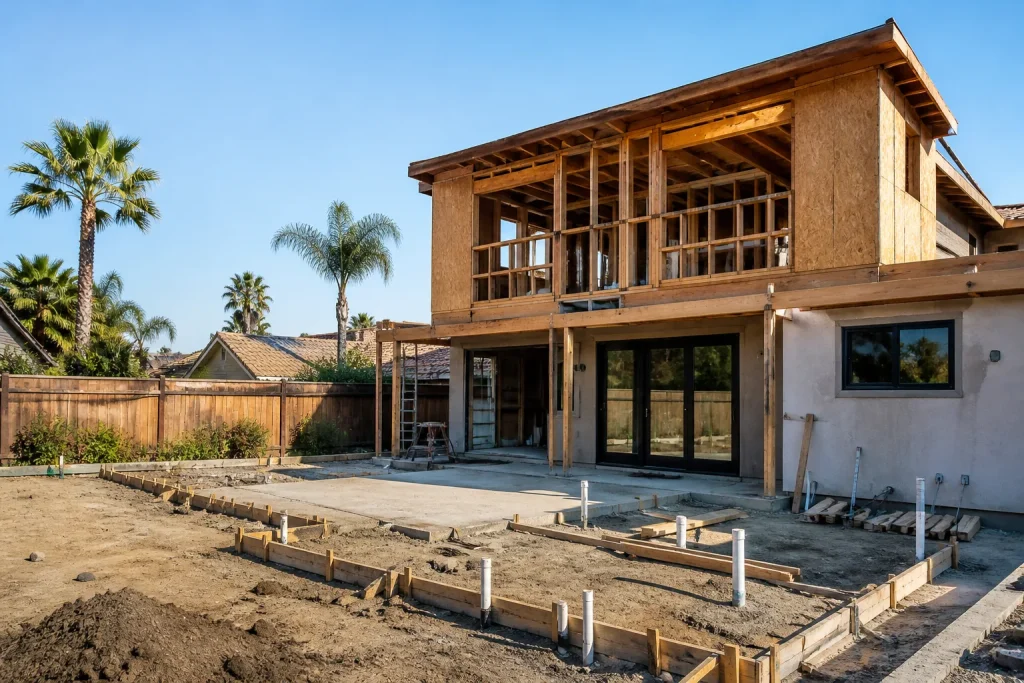
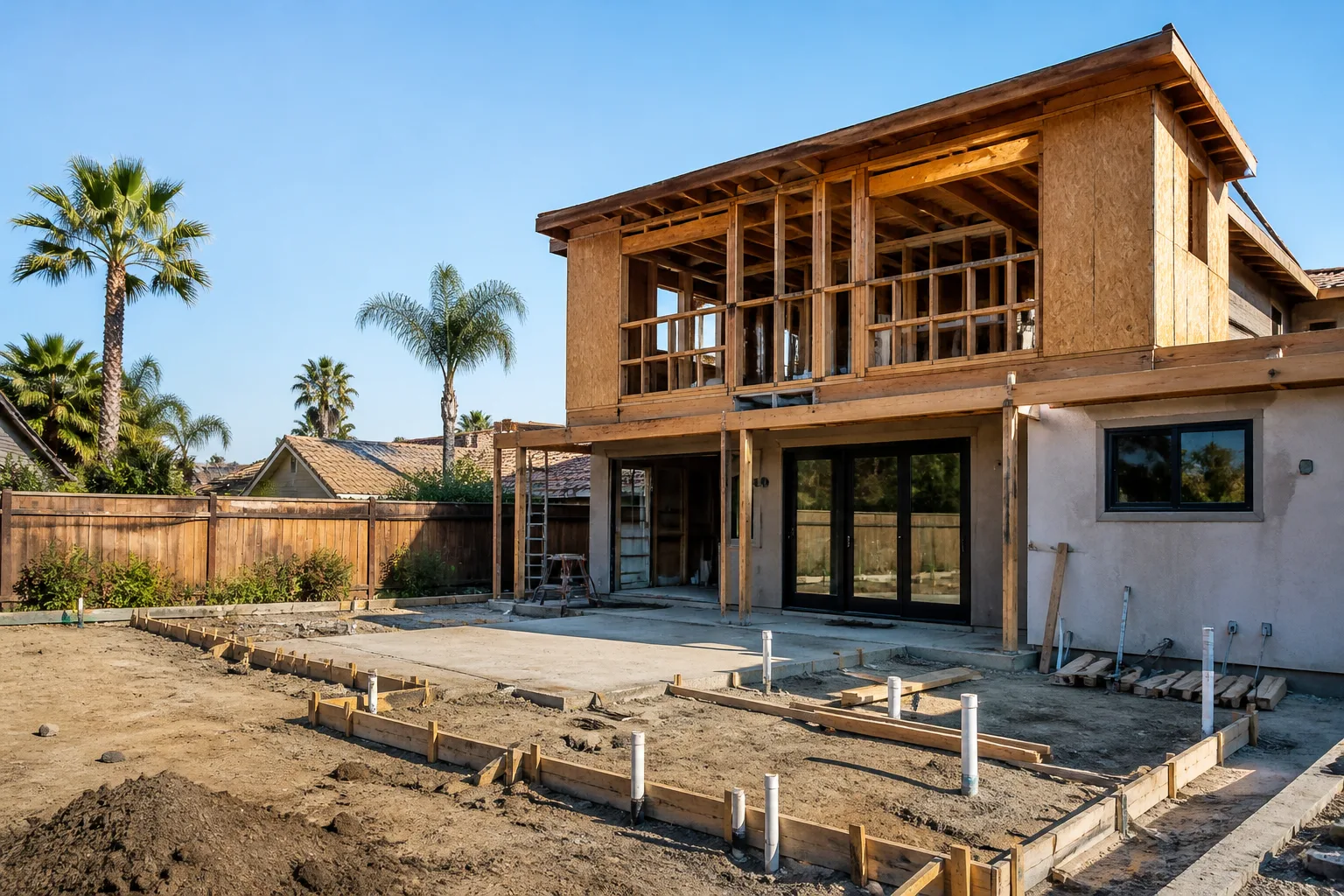
5 Mistakes to Avoid With Home Additions & ADU
Irvine approves a lot of ADUs. The city has been friendly to accessory dwelling units for years, and the approval rate reflects it. But roughly 30% of first submissions still come back requiring a redesign, and the reason is almost always the same: the homeowner made a permanent decision before confirming the data that would have changed it. Setbacks, floor area ratio, utility capacity, licensing requirements. All checkable before a single line gets drawn. Here are the five mistakes we see most in Irvine, what they cost, and how to skip them.
If you’d rather have someone who knows the terrain walk you through it, call (888) 578-4462. The estimate is free and the design consult is included.
Mistake 1: Skipping the Pre-Application Meeting With Irvine’s Community Development Department
The single highest-value hour in an Irvine ADU project is a pre-application meeting at the Community Development Department. It’s free, and it will tell you more about your specific lot than a month of online research. No forum thread knows your setbacks. No blog (including this one) can read your parcel’s zoning envelope. The city can.
Most homeowners skip it because they assume the architect or contractor will handle zoning. Sometimes that works. But a pre-app meeting puts the constraints on the table before money moves, and that changes which questions you ask everyone afterward.
What to bring:
- Your parcel number and a printout of the lot’s zoning designation. Irvine has multiple zoning categories, and ADU rules attach to the zone.
- A rough site plan – hand-drawn is fine – showing where you’re thinking of putting the unit.
- Your HOA info if you have one. Many Irvine village associations layer their own restrictions on top of city code, and those restrictions bind you whether or not the city cares.
- A list of your actual questions. Write them down. People forget half of them in the room.
In our experience, the homeowners who attend the pre-app meeting walk away with two or three constraints they didn’t know they had. Better to hear them from a planner than from a rejection letter six weeks and several thousand dollars of drawings later.
Mistake 2: Never Checking Your Electrical Panel and Sewer Lateral
This is the one that hurts most, because it surfaces mid-project, when the foundation is poured and the drywall is going in. A detached or attached ADU needs meaningful power. If your existing panel is already maxed out with a kitchen, an EV charger, and central air, adding a dwelling unit can trigger a full panel upgrade or even a service upgrade from Southern California Edison. That’s real money, and it’s not in the drawings.
Sewer is the same story. Many older Irvine homes have a lateral that’s undersized for two dwellings or already carrying tree roots. A scope-and-inspect before design costs a few hundred dollars. Discovering it after the slab goes down costs thousands.
What to check before you draw anything:
- Panel capacity. Have an electrician do a load calculation. Not a guess. A calculation.
- Sewer lateral condition. Camera inspection, especially on homes older than roughly 25 years.
- Water service size. A second dwelling adds a second set of fixtures.
- Gas capacity if you’re planning a gas range or water heater in the unit.
We pulled a set of drawings off a job in Turtle Rock last spring where the homeowner had already paid for a full permit set. Then the load calc came back and the panel needed a service upgrade the design didn’t account for. Two sets of drawings. One problem nobody checked first.
Mistake 3: Hiring an Architect Before You Know Your Zoning Envelope
Design-first feels responsible. It’s actually the most common way homeowners in Irvine pay twice for drawings. Here’s the trap: you hire an architect, they design a beautiful 800-square-foot unit, and then you find out the lot’s floor area ratio (FAR) allowance or setback requirement only supports 550. The architect redraws. You pay again.
The zoning envelope comes first. It defines four things:
- Maximum buildable area based on FAR and lot coverage for your zone.
- Setbacks – front, side, rear – which dictate where the unit can physically sit.
- Height limits for single-story versus two-story additions.
- Parking requirements, which in Irvine can surprise people who assumed ADUs are exempt from parking. California law has narrowed that exemption, but “narrow” isn’t “never.”
Some Irvine lots have generous envelopes. Some are tight. You can’t tell from the street. Confirm the numbers first, then hire the designer with a known box to work inside. It costs nothing extra and prevents the single most expensive redesign category we see.
Mistake 4: Assuming a General Remodeling License Covers ADU Work
California’s ADU rules are their own animal. A general remodeling contractor can hold a valid license and still not have the ADU-specific experience to navigate the state’s recent ADU framework, the city’s local amendments, and the inspection sequence that Irvine expects. Licensing and experience aren’t the same thing. Both matter.
What to verify before you sign anything:
- Active California contractor license in the correct class for the scope of work.
- Experience with ADU-specific permitting, not just remodeling. Ask for the address of a completed unit you can drive past.
- A contractor who pulls the permits themselves, in their name, not yours. If the application goes in under your name, you carry the liability for unpermitted work.
- A written scope with line-item pricing, not a lump sum with a change-order clause attached.
We’ve had homeowners walk us through a previous bid where the “contractor” was a handyman holding no license at all, applying for an ADU permit. That project doesn’t end well. The permit gets pulled under the homeowner’s name and the work goes unverified. It’s the setup for every problem in the next section.
Mistake 5: Building Without a Permit and Assuming It Stays Quiet
Unpermitted additions don’t have a statute of limitations in California. The county can discover a decade-old unpermitted ADU at any point, and the homeowner carries the consequences regardless of who built it or when. Those consequences reach further than most owners realize.
Where unpermitted work bites you:
- Homeowner’s insurance. Many policies exclude damage to or caused by unpermitted structures. A fire originating in an unpermitted unit can turn into a claim dispute.
- Mortgage refinance. Appraisers flag unpermitted square footage. Lenders generally won’t finance it, which shrinks your valuation.
- Eventual sale. Buyers’ inspectors find it. Disclosures surface it. Your buyer’s lender may require it be legalized or removed before closing, and buyers price that risk in.
- Code enforcement. Irvine enforces code. A neighbor complaint is enough to open the file.
Legalization after the fact is expensive and sometimes impossible. The permitted path costs more up front and dramatically less over the life of the property. If you’re weighing an addition alongside other exterior work, it’s often worth sequencing them together. Home Additions & ADU in Irvine covers the permitted route, and coordinating pavers, fencing, or windows into the same project timeline usually saves on mobilization. See Driveway & Pavers in Irvine and Fence Installation in Irvine for the exterior side.
When to Call a Pro (And When You Can Do It Yourself)
Some parts of an ADU project are genuinely DIY. Attending the pre-application meeting, gathering parcel records, jotting a rough site sketch, shopping material brands. Those cost you time and save you real money. Unilock, Tremron, Techo-Bloc, and Cambridge Pavers all have retail lookbooks you can browse to pick a driveway surface that ties into an ADU entry path – that’s homework, not construction.
Everything structural, electrical, plumbing, or permitting-related goes to a licensed pro. That’s not a sales line. That’s the line where a mistake is irreversible. If you’re weighing a Groundwork project, we quote everything as a line item and put it in writing. Upfront pricing, no surprises. And if the design consult turns up a constraint you didn’t know about, you hear it before the drawings, not after. Groundwork Construction Co. of Irvine home gives you the full picture of what we do.
The Bottom Line
Every mistake on this list shares a root cause: making an irreversible decision before checking the data that would change it. Confirm your zoning envelope first. Scope your utilities second. Bring both to the pre-application meeting. Hire a licensed contractor who pulls their own permits. And skip the unpermitted route entirely – the savings are an illusion and the liability follows the property, not the builder.
If you’re in Irvine and want help with any of this, Groundwork Construction Co. of Irvine offers free estimates and a free design consult. Call (888) 578-4462. Our technicians have up to 12 years of experience, and every walkthrough is answered by a live person, 24/7.
Frequently Asked Questions
A permitted detached ADU in Irvine typically runs $180,000 to $350,000 depending on size, site conditions, and finish level. Attached units and garage conversions generally run lower. Utility upgrades – panel, sewer, water – can add $8,000 to $25,000 if the existing infrastructure needs replacement. Call (888) 578-4462 for a line-item estimate on your specific lot.
Yes. All ADUs in Irvine require a building permit, and the permit application should go in under the licensed contractor’s name, not the homeowner’s. Unpermitted ADUs have no statute of limitations protection in California and can affect insurance, refinance, and resale. Call us for help confirming what your project requires.
Plan on 8 to 14 months from first meeting to final inspection for a detached unit, with permitting taking a meaningful chunk of that. Attached units and garage conversions often run 5 to 9 months. Site conditions, utility upgrades, and design revisions all shift the timetable. A pre-application meeting in Irvine is the fastest way to firm up your specific timeline.
Yes, garage conversions are one of the most common ADU routes in Irvine and generally cost less than a detached build. The catch is you lose the parking spot, and some Irvine village associations and lots have parking minimums that affect approval. Confirm this at the pre-application meeting before you draw. Call (888) 578-4462 for a free consult on your conversion.
Written by the team at Groundwork Construction Co. of Irvine.
Need Construction Help?
Call Groundwork Construction Co. of Irvine - licensed & insured, here with fast after-hours help in Irvine.
(888) 578-4462